

Candle Labels in the EU and UK: Safety Warnings, CLP and What to Plan For
What goes on a candle label sold in the EU and UK: fire safety warnings, CLP hazard labelling for scented candles, product identification and contact details, online listings, and the new CLP formatting rules.
On a shelf, a candle label sells the product. In the EU and UK, it also has to carry safety information, and for many scented candles, chemical hazard information too. Brands often design a beautiful label first and discover later that there is no room for the warnings their market requires. This guide explains the information a candle label usually has to carry, where each part comes from and how to plan the space before the artwork is final.
The short answer
- Fire safety warnings: candles carry safety symbols and texts for burning; EN 15494 is the European standard for candle product safety labels.
- CLP hazard labelling: depending on the fragrance and how much of it is used, a scented candle can need a hazard label under the EU CLP Regulation, or at least an allergen statement. The Safety Data Sheet (SDS) for your exact formula shows what is needed.
- Who and what: the label and packaging identify the product (type, batch or serial number) and who is responsible for it, with postal and electronic contact details.
- Language: safety information must be in a language consumers in each country can easily understand, as decided by that country.
- Online: your listing must show the same warnings and safety information as the product.
- Great Britain has its own version of CLP; Northern Ireland follows the EU rules.
- Plan early: agree on the warnings before the artwork is final. Our in-house designers prepare label artwork for free and leave space for the safety text you supply.
1. Fire safety warnings
Every candle is a naked flame, so the label tells customers how to burn it safely. EN 15494 is the European standard for candle product safety labels. It builds the label from a general warning sign plus supplementary safety symbols or texts, and its 2019 revision sets which of them are mandatory for which type of candle. Typical warnings cover never leaving a burning candle unattended, keeping it out of reach of children and pets, and keeping it away from anything that can catch fire.
A few practical points from the standard:
- The supplementary symbols sit next to the general warning sign.
- The safety information has to be on the product label itself; an instruction leaflet alone is no longer enough.
- If space is tight, extra information can go on a peel-off or fold-out label, as long as the mandatory information is shown and the label points to the rest.
Ask your Responsible Person or test lab which symbols apply to your candle type, and reserve space for them in the design.
2. CLP: when the fragrance changes the label
Under the EU CLP Regulation (classification, labelling and packaging of chemicals), suppliers have to classify and label hazardous mixtures. Fragrance oils contain substances that can be skin sensitisers or harmful to aquatic life. Depending on the formula and the fragrance load, a scented candle can be classified as hazardous and need a CLP hazard label.
A CLP hazard label includes:
- The name, address and telephone number of the supplier
- The nominal quantity, for products sold to the general public
- Product identifiers
- Hazard pictograms, a signal word, and hazard and precautionary statements, where they apply
- Any supplemental information that applies
Even when a candle is not classified as hazardous, it may still need an allergen statement. According to ECHA, a mixture that contains a sensitising substance at or above one tenth of the concentration that would classify it carries the statement “Contains (name of the substance). May produce an allergic reaction.”
Two things follow from this:
- Each scent needs its own check. Two candles in the same jar, with different fragrances or different fragrance loads, can need different labels.
- The SDS is the starting point. Section 2 of the SDS sets out the classification and label elements, and section 3 sets out the composition. Ask for the SDS for each formula with your quote, and plan your label from it.
Mixtures classified for health or physical hazards also need a UFI (unique formula identifier) on the label, linked to a notification to the poison centres. ECHA’s guidance indicates that a mixture labelled only with the allergen statement does not need one.
3. Product identification and contact details
The EU General Product Safety Regulation (EU) 2023/988, which applies from 13 December 2024, sets out what must identify the product and the people behind it:
- Product identification: a type, batch or serial number that consumers can easily see and read.
- Manufacturer details: the manufacturer’s name, registered trade name or registered trade mark, with a postal and an electronic address.
- A responsible economic operator in the EU: a product can only be placed on the EU market if an economic operator established in the EU is responsible for it.
- Instructions and safety information: in a language consumers can easily understand, as determined by the EU country where the product is sold.
The revised CLP rules also state that a supplier established in the EU must be identified on the label of a hazardous mixture. In practice, this usually means your brand’s or importer’s details on the label, next to or instead of the factory’s.
4. Selling online
Online listings have their own rules. Under the General Product Safety Regulation, an online offer must clearly show:
- The manufacturer’s name or trade mark, and a postal and electronic address
- Where the manufacturer is outside the EU, the name and address of the responsible person in the EU
- Information that identifies the product, including a picture of it
- Any warning or safety information that has to be on the product
For hazardous mixtures, the revised CLP Regulation adds that, from 1 January 2028, offers for distance sales must clearly show the CLP label elements, so online stores will have to display hazardous properties clearly on their websites. If you sell on a marketplace or your own web shop, add the warnings to your product listing as well as to the label.
5. The new CLP formatting rules
CLP was revised by Regulation (EU) 2024/2865, which entered into force on 10 December 2024, and most of its new obligations apply from 1 July 2026. The new label formatting rules set minimum text sizes that depend on the size of the package, add other legibility rules and allow fold-out labels more widely. Regulation (EU) 2025/2439 postponed these formatting rules, together with the new rules for advertising and distance sales, to 1 January 2028.
The EU is also working on simplifying the formatting rules further, so check the current text before you finalize your artwork. If you are designing a label now, leaving generous space for the safety information and using a clear, legible font is the simplest way to be ready.
6. Great Britain and Northern Ireland
In Great Britain, chemicals placed on the market are classified and labelled under GB CLP, which is regulated by the Health and Safety Executive (HSE). A business in Great Britain that brings in products from outside and places them on the GB market is treated as an importer under GB CLP. Northern Ireland follows EU CLP.
If you sell in both the EU and Great Britain, check both sets of rules with your Responsible Person or importer, and plan a label that has room for the details each market needs.
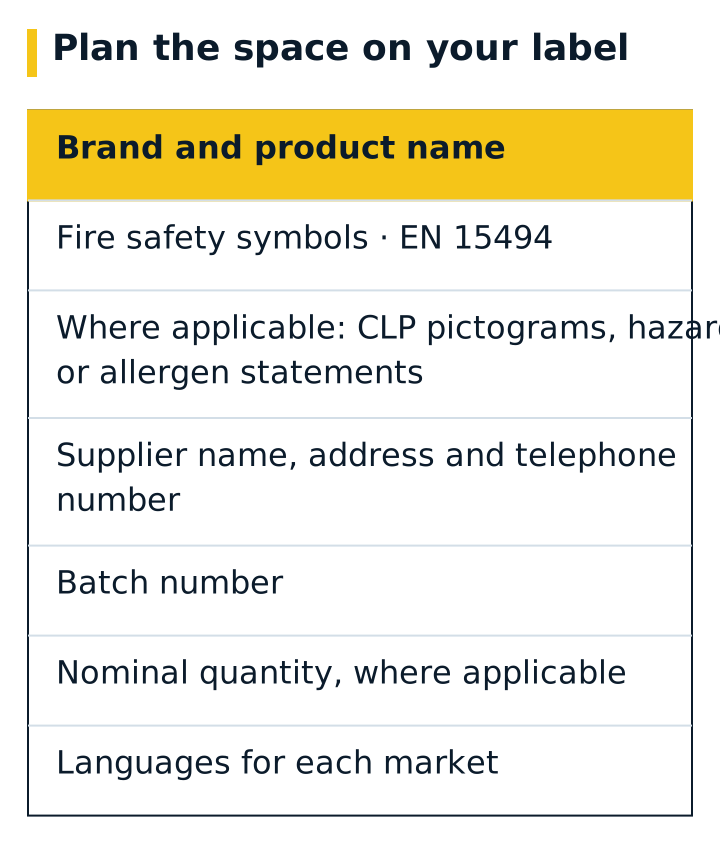
Label planning checklist
- SDS for every scent and formula you order
- Hazard pictograms, statements and allergen statements confirmed for each scent
- Fire safety symbols agreed for your candle type
- Your brand or importer’s name, postal and electronic address
- A batch or type number on the product
- Nominal quantity, where it applies
- The languages for each country you sell in
- Room for a UFI if a scent is classified for health or physical hazards
- The same warnings in your online listings
What we provide
- An SDS for each formula, so you know what each scent needs on its label.
- EN 15493 candle fire safety reports for our candle lines.
- Free label and packaging artwork from our in-house designers, laid out with space for the safety text and symbols you supply.
- Physical samples, so you can check the finished label on the real product before bulk production.

Frequently asked questions
Do all scented candles need a CLP hazard label? Not all. It depends on the fragrance and how much of it is used. The SDS for your formula shows whether the candle is classified and which label elements it needs.
Can one label design work for all my scents? The design can, but the safety text may change from scent to scent. Leave a panel where the hazard and allergen information can change while the rest of the label stays the same.
Who decides the final label? The supplier who places the product on the market, usually your brand or importer, is responsible for the label. We provide the SDS and other documents and print the text you approve.
Can you print labels in several languages? Yes. Our designers can lay out the label with the languages you need. You supply and approve the wording for each market.
This guide gives general information, not legal advice. Check the requirements for your exact product and markets with your Responsible Person, importer or a regulatory specialist.
Plan your label with us
Send us your scents, your target markets and a rough quantity. We will confirm which documents cover each formula, prepare the label artwork with space for your warnings, and make samples so you can check everything on the finished product. Samples of our standard products are free; you pay the courier. Samples made to your own design are charged. Design work is free.
See our scented candle range · Read: CPSR for candles and home fragrance · Get a quote