

CPSR for Candles and Home Fragrance: What EU and UK Buyers Need to Know
Which candles and fragrance products need a Cosmetic Product Safety Report (CPSR) in the EU and UK, what the report contains, who is responsible for it, and which documents to ask your factory for.
“Do you have a CPSR?” is one of the first questions EU and UK buyers ask a candle factory. The honest answer is: it depends on the product. A CPSR, or Cosmetic Product Safety Report, is required for cosmetic products. Many candles and home fragrance products are not cosmetics at all, but some, like massage candles and body sprays, are. This guide explains which products need a CPSR, what the report contains, who is responsible for it and what you should ask your factory for.
The short answer
- A CPSR is required for cosmetic products sold in the EU under Regulation (EC) No 1223/2009, and in Great Britain under the version of that Regulation that applies there.
- A cosmetic product is one intended to be placed in contact with the external parts of the human body, for purposes such as cleaning, perfuming or protecting it.
- Scented candles, reed diffusers and room sprays are not applied to the body, so they are generally not cosmetics. Other rules apply to them, such as general product safety rules, hazard labelling and candle safety standards.
- Massage candles are poured onto the skin, so they are generally treated as cosmetic products and need a CPSR. The same applies to sprays meant for the skin.
- The Responsible Person, established in the EU (or in the UK for Great Britain), is legally responsible for the CPSR, not the factory. For imported products, that is usually the importer.
- Our documents: our massage candle line has CPSR reports for both the EU and the UK, our fragrance spray line has a CPSR for the EU, and EN 15493 and SDS documents are available for our candle lines. Both lines are also notified in the EU (CPNP) and the UK (SCPN); a product sold under your own brand still needs its own notification through your Responsible Person.
What a CPSR is
The CPSR is the safety report required by Article 10 of the EU Cosmetics Regulation. Before a cosmetic product is placed on the market, it must undergo a safety assessment, and the report must follow Annex I of the Regulation. Annex I splits it into two parts:
- Part A, cosmetic product safety information: the product’s composition, physical and chemical characteristics and stability, microbiological quality, impurities and packaging information, normal and reasonably foreseeable use, exposure, the toxicological profile of the substances, undesirable effects and other product information.
- Part B, cosmetic product safety assessment: the assessment conclusion, labelled warnings and instructions of use, the reasoning, and the assessor’s credentials and approval.
The assessment must be carried out by a qualified safety assessor: someone with a university qualification in pharmacy, toxicology, medicine or a similar discipline.
The CPSR is part of the Product Information File (PIF), which the Responsible Person keeps for ten years after the last batch of the product is placed on the market.
Which products need a CPSR
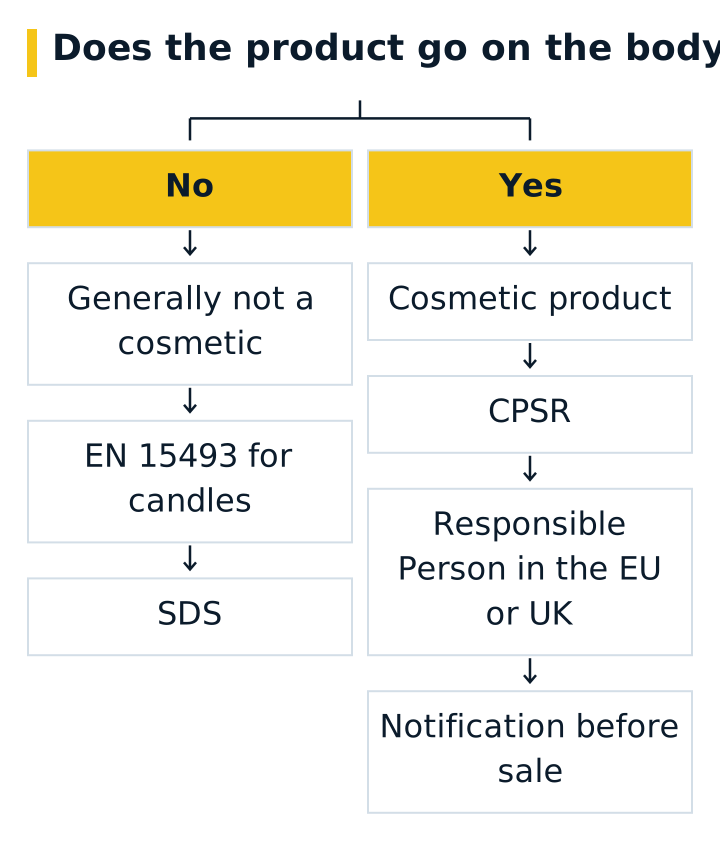
The question to ask is simple: is the product intended to go on the body?
| Product | On the body? | Cosmetic? | Ask for |
|---|---|---|---|
| Scented candle | No | Generally no | EN 15493, SDS |
| Reed diffuser | No | Generally no | SDS |
| Room or linen spray | No (rooms, fabrics) | Generally no | SDS |
| Body spray or perfume | Yes | Yes | CPSR; IFRA for perfume |
| Massage candle | Yes (the melted oil) | Treated as cosmetic | CPSR, EN 15493, SDS |
Two products need extra care:
- Massage candles are both a candle and a skin product. That is why our massage candle line is backed by CPSR safety reports for the EU and the UK, with EN 15493 and SDS documents for the candle side.
- Multi-use sprays can fall on either side. If your spray is sold only for rooms and fabrics, it is generally not a cosmetic. If your label or marketing suggests spraying it on skin, it is likely to be treated as a cosmetic and need a CPSR. Decide the intended use before you design the label.
Who is responsible for the CPSR
Under the EU Cosmetics Regulation, a cosmetic product can only be placed on the EU market if a Responsible Person is designated within the EU. For imported products, each importer is the Responsible Person for the products it places on the market, unless it designates another EU-established person by written mandate.
The Responsible Person must:
- Make sure the product has had a safety assessment and that a CPSR exists before it is placed on the market.
- Keep the Product Information File, including the CPSR.
- Notify the product to the European Commission electronically before it is placed on the market. This is done through the Commission’s notification portal, known as the CPNP.
In Great Britain, the rules are similar but separate. The Responsible Person must have a UK-established address (a PO box or mail-forwarding address does not count), keep the PIF in English and notify the product to the Office for Product Safety and Standards (OPSS) through the Submit cosmetic product notifications service before it is made available. Northern Ireland follows separate rules, and the Responsible Person for Northern Ireland must be established there or in the EU.
A factory outside the EU and UK cannot take on this role for you. What the factory can do is supply the information and documents the Responsible Person needs.
What the factory provides and what you arrange
| The factory provides | You or your Responsible Person arrange |
|---|---|
| Formula and composition information for the safety assessment | A Responsible Person in the EU, the UK, or both |
| An existing CPSR for the factory’s formula, where one exists | Confirmation that the safety report covers your exact product |
| SDS for the formula | The Product Information File |
| Samples and product details for testing | Notification before the product goes on sale |
| Label artwork with space for the required information | The final wording of warnings and directions on the label |
If the factory already has a CPSR for the formula you are buying, ask whether it matches your exact product and how it can be used for your Product Information File. Your Responsible Person decides what they need.

When the CPSR has to change
A CPSR assesses a specific product, starting with its exact composition. If you change the fragrance, the oil blend or another ingredient, the safety assessment needs to be reviewed for the new formula.
For a massage candle range with several scents, plan your scents before you order, and ask which of them are already covered by the factory’s documents. Adding a new scent later is possible, but it means new paperwork as well as a new sample.
Products that are not cosmetics
Scented candles, reed diffusers and room sprays still have rules. They are not covered by the Cosmetics Regulation, but they are covered by general product safety rules. In the EU, the General Product Safety Regulation (EU) 2023/988 applies from 13 December 2024. It requires an economic operator established in the EU to be responsible for products placed on the EU market.
For candles, EN 15493 is the European fire safety specification, and our candle lines have EN 15493 reports. Fragrance products such as diffusers and sprays can also need hazard labelling depending on the formula; the SDS sets out the classification your label is based on.
What to ask your factory
- Is this product a cosmetic, or is it sold for rooms and fabrics only?
- For cosmetic products, is there a CPSR for this exact formula, and for which market (EU or UK)?
- Which scents does the report cover?
- Is there an SDS for each formula?
- For candles, is there an EN 15493 report?
- Can the label artwork leave space for warnings, directions and your Responsible Person’s details?
Frequently asked questions
Do scented candles need a CPSR? Generally no. A scented candle is not applied to the body, so it is not a cosmetic product. Ask for the EN 15493 fire safety report and the SDS instead.
Do massage candles need a CPSR? Yes. The melted oil is poured onto the skin, so massage candles are generally treated as cosmetic products. Our massage candle line is backed by CPSR safety reports for the EU and the UK.
Can the factory be my Responsible Person? No. The Responsible Person must be established in the EU for the EU market, or in the UK for Great Britain. For imported products, that is usually the importer, or an EU or UK company it appoints.
Can I use the factory’s CPSR? Ask whether it covers your exact formula and market. Your Responsible Person decides whether it can be used in your Product Information File.
This guide gives general information, not legal advice. Check the requirements for your exact product with your Responsible Person or a regulatory specialist.
Start with the right documents
Tell us which products you plan to sell and in which markets. We will tell you which documents we have for each product, and send samples so you can start your own checks. Samples of our standard products are free; you pay the courier. Samples made to your own design are charged. Design work is free.
See our massage candle range · Read: wholesale massage candles · Get a quote